
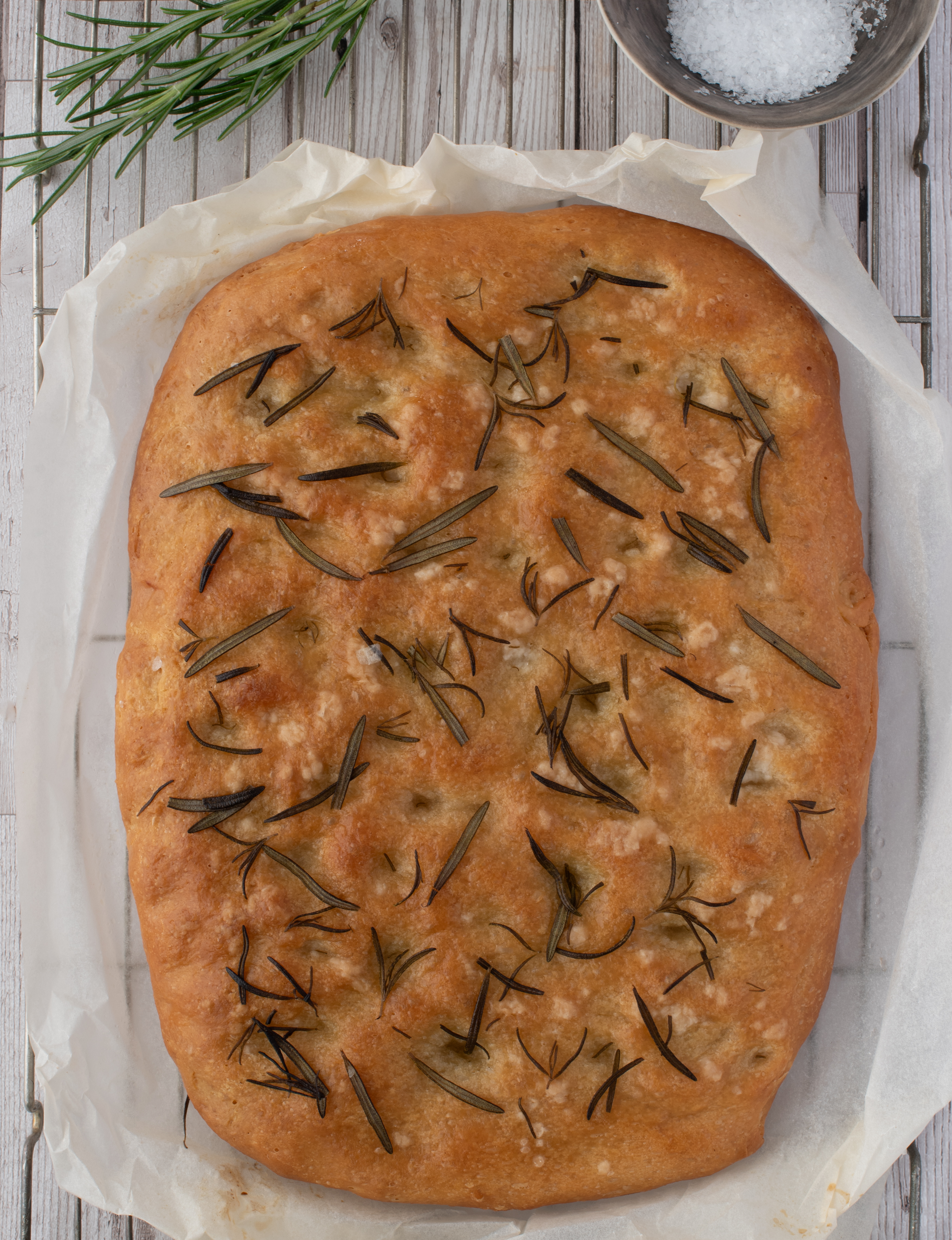
I call this first-time focaccia because it’s a straight forward recipe that you can try as one of your first bread bakes. I often use it when showing budding bakers how to make their first recipes. It increases confidence because it usually works out really well. Give it a try and see if it makes you feel encouraged to bake more, as well as enjoying the tasty end result.
Ingredients
300g strong white bread flour
175g room temperature water
45g olive oil
7g of fast action yeast
1 tsp table salt
Topping – after first prove
1 large sprig of rosemary – removed from the hard stalk
60g olive oil – for topping
1 tsp salt flakes for sprinkling on top before baking
Extra utensils
Mixing bowl and spoon
Jug
Scales
Small bowl
Heavy baking sheet or roasting tin (larger than 20cm x 25cm)
Long ruler or tape measure
Cling film or plastic proving bag
Method
Weigh the flour into the mixing bowl. Add the yeast and stir it into the flour.
Add the 175g of water and 45g of olive oil into the mixing bowl. Add the salt last and then mix with a wooden spoon or with the dough hook on an electric mixer. Mix for a couple of minutes until you have a shaggy dough.
Next you can knead the dough or you can continue with an electric mixer. For kneading by hand, add a little oil to your worktop and knead the sticky dough for 6 minutes. As you knead it, there may be a sticky stage before you come out the other side to a smooth stretchy dough. You can use a dough scraper to gather any dough sticking to the worktop each time you knead. Just at the point where you feel it is never going to change, you will turn that corner, I promise. If using the electric mixer with the dough hook, do this on a medium speed for 5 minutes.
Put your dough into your clean, lightly oiled bowl. Cover the bowl with a clean tea towel and leave it to prove in a warm place like an airing cupboard for about 1 hour, until it has doubled in size. The time it takes will depend on the seasons. On a warm day an hour should be plenty with the bowl placed on the worktop. On a colder day it may take a little longer and will need the airing cupboard or in the oven with only the light switched on. If you’re not sure about how to tell when it has doubled, take a photo of the dough when you place it into the bowl. This should help you compare it.
While the dough is having its first prove, we can flavour the olive oil. Mix 60g of olive oil with the rosemary leaves in a small bowl. Then use a teaspoon to crush them against the side of the bowl a little just to release the flavour. Leave to stand.
After an hour, lightly grease your heavy baking sheet or roasting tin and line it well with greaseproof paper. The olive oil may seep out the sides once the focaccia has its topping, so allow for this by using enough greaseproof paper to capture it.
Take your dough out of the bowl and gently place it onto your baking sheet or in your tin. Stretch your dough to an even depth, with your hands to about 20cm x 25cm. And if the dough won’t stretch any more, it will grow some more after the next prove.
Using your fingers, make little dips in your dough, but don’t push right to the bottom. Drizzle your rosemary and olive oil all over the focaccia. It should puddle in the little dips. Sprinkle 1 tsp of salt flakes over the focaccia.
Cover the dough loosely with cling film or put the baking sheet or tin into a plastic proving bag and a clip on the end. Leave it to rise at room temperature this time for about 30 – 60 minutes. You are looking for it to have increased in size. Resist from pushing any more dips into the dough at this point.
Preheat your oven towards the end of the proving time to 200°fan/220°C/gas 7.
Place your baking sheet or tin containing your dough into the oven. Bake for 25 minutes or until a lovely golden colour.
When you take your focaccia out, place the tray or tin on a cooling rack.
Eat while still warm with your favourite accompanying dish or with a deli selection of olives, cheeses and or meats. Focaccia, like most breads is at its very best the same day. But it can be wrapped or placed in a tin for up to three days. A little warming, if it goes a little solid, helps to soften it again. You can also wrap and freeze it for up to a month, as a whole focaccia or cut into squares.
If you enjoyed this recipe and want to try more, you can order a copy of my recipe book here.
Copyright The Doorstep Baker, Catherine Lloyd-Williams
Reviews
Samantha, 2024
“I gave my Dad your recipe book. He made the easy focaccia bread and it was divine!! Fabulous recipe.”
Want to know more?
Read or sign up to the newsletter, to find out what else is coming Newsletter
 The Doorstep Baker