
You want to make a sourdough starter or you’ve just inherited one. What now?
To make one, read on.
To feed an existing one, scroll down to feeding your starter and use the trouble shooting tips there too.
A sourdough starter is kept in a pot to make sourdough loaves again and again. One starter will be fed with flour and water and then the left over amount is kept, for the next time you want to make a sourdough. The cycle then repeats each time.
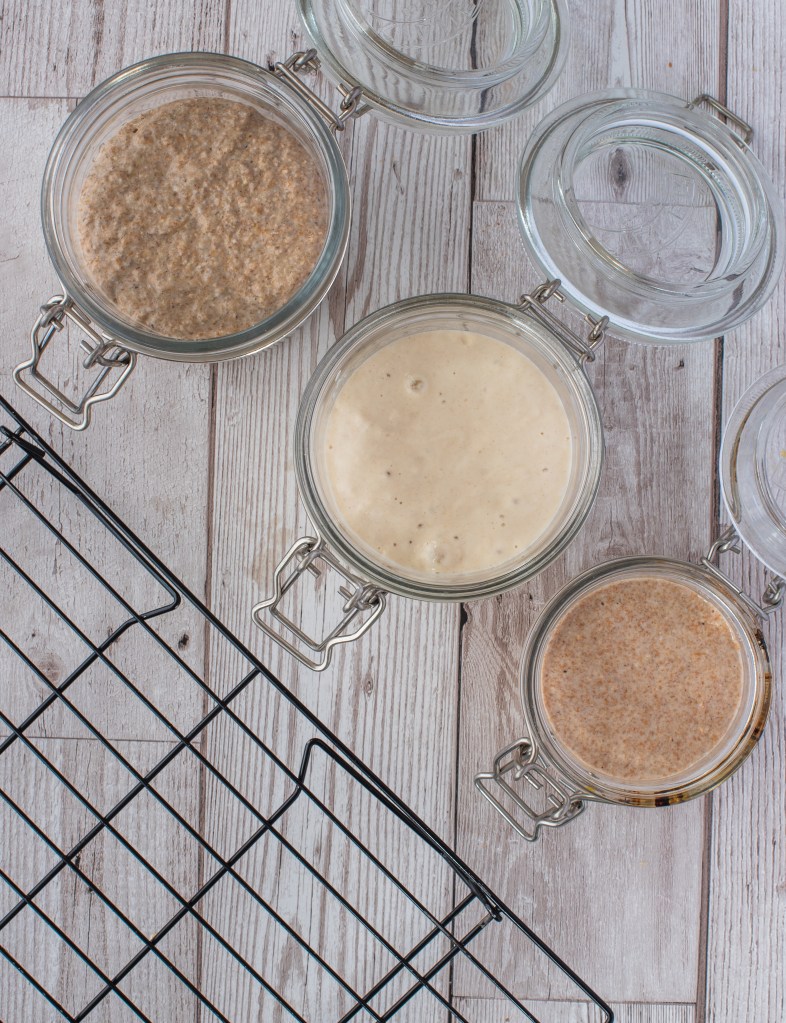
The starter is what is often described as a ‘wild yeast’. It is a different yeast to the dried ones used in many recipes. It is made from strong bread flour and water. We allow the naturally existing yeasts in the flour and the air to activate it, by leaving the lid off. WHAT? I hear you say. What are these things we cannot see? I know! Once you get over the surprise or even the alarming feeling from this fact, you can marvel at the thought that you can make bread from wild and free yeast. Sustainable or what? And with this starter, we store it and then feed it from time to time. It can be your pet if you so choose, but feeding it every day, once it’s matured, isn’t compulsory. I feed mine twice a week as standard. Then more if I’m doing more baking days. I use my starters to bake sourdough loaves, pizza, focaccia, cookies and so much more. My pet starters are The 3 Vs – The mature rye starter, Gordon the mature white flour, and Wilf the adolescent wholemeal. I am also proud that one of my lockdown delivery customers recently made one and named hers after me. Thanks, Frances!
Something to note: A wholemeal or rye flour starter are often used in artisan bakeries to make any sourdough loaf, including white flour ones. You can be tempted to make a white one, which is fine, but you may get a flatter less structured loaf with only white starter.
As your starter ages it will produce better and better loaves with more open holes. It takes time to mature and I would say, a starter that is 6 months old or more will get the more traditional looking sourdough you want. But you can still make and eat sourdough with younger starters in. It may have smaller holes, but it tastes great and just be patient. I know its hard to wait, but its worth it!
Ingredients
600g–900g strong bread flour of your choice: dark rye, white or wholemeal. It’s best to use one flour and stick with it. You can make more than one starter at a time if you want a different bread flour in each one.
Room temperature water (for the amounts see the method below).
Extra utensils
A 1 litre clean Tupperware box with tight fitting lid.
Method
Read this recipe and the troubleshooting guide through before you start, to get a feel for what is okay in making your starter.
Starter day 1
Mix 200g of your bread flour with 200g of tepid water in the mixing bowl, until no lumps remain. Pour or spoon it into your chosen box. Keep the lid off and put it somewhere warm overnight, which will depend on the time of year. An airing cupboard is often good in the winter. A warm kitchen in the late spring or summer will be fine.
Starter day 2
Get the pot with your starter in. Throw away about half of your starter – I know it seems brutal, but you will just end up with too much. Add 100g of tepid water and 100g of your bread flour and mix it with a wooden spoon until incorporated. Leave the lid off and return it to somewhere warm again.
Starter day 3
Repeat all of the processes you did on starter day 2, including discarding half of the starter first.
Starter days 4, 5 and 6
Your mixture is taking in natural yeasts from the air. It will gradually start to be living in a lively way. If things aren’t happening as quickly as you’d like, keep trying and have faith that things will happen for your starter.
For days 4, 5 and 6 – repeat the full process of starter day 2.
What you will begin to see are little bubbles in the flour and water mixture. Once you get these bubbles you are creating a live, natural yeast! You are creating something from seemingly nothing! You are ready to make your first sourdough recipe. How amazing is that? The longer you keep using this starter, the more it will mature and the better your loaves and bakes will become.
The next step, once you have lots of bubbles and you are ready to make your loaf, is to weigh out the starter amount needed for your recipe, after it has been fed and rested over night (see feeding your starter, below). You can then keep the rest of your starter in your box and place it in the fridge with the lid on. Before feeding the starter for your recipe, you will need to bring your starter out of the fridge and let it sit at room temperature for a couple of hours. Then feed it for the recipe, usually the night before making the dough. A starter that is new will bake very differently to a starter that is at least 6 months old or older. But both will turn out loaves with tasty results.
If you are not ready to make a sourdough recipe yet, put the lid on your container, put it in the fridge and feed it at least once a week, as described below. People baking every day don’t need to refrigerate their starters as it is in a constant cycle of feeding and usage.
Keeping your starter alive
Feeding your starter once a week will mean that it is lively and ready to be put to use. I often feed the starter by bringing it to room temperature the evening before I am due to make a sourdough. I then feed it using the steps below. I often then leave it out overnight and then it is lively and ready to use the following morning for baking.
Feeding your starter
Get the starter out of the fridge at around 5pm and leave it on your kitchen counter with the lid on this time for about 2 hours. You can be flexible with the time you start. And in summer I feed the starters later at night due to the heat speeding up the starter activity.
Feed the starter by repeating the process of starter day 2 on page 21, but put the lid back on the container. Leave the starter on the counter, with the lid on until you come to use it the next morning. In the morning weigh the amount of starter needed for your recipe. Put the rest back in the fridge with the lid on, remembering to feed it once a week.
Troubleshooting
If your starter amount is getting too big for the container you can either discard some or you can get a bigger container to put it in.
It’s okay if the starter smells strong and gluey, this is the natural yeast doing its thing.
It’s okay if the starter has a greyish layer on the top. This is called ‘hooch’. You can pour it off or stir it in. Leaving it in adds to the sourness, if you enjoy that.
You can use various types of flour for a starter. Wholemeal, dark rye and white bread flours are popular ones to use. I would recommend using one flour type in one starter.
Don’t be scared of making mistakes and don’t be put off if it feels like it isn’t working. I made lots of mistakes and it’s where we truly learn about how to bring the starter to a workable state.
Don’t be tempted to throw away your starter if it feels like it isn’t going right. Keep persevering with it. You can always start another one off. Some people have many different types of starters in their possession. Unless there are signs of an unusual mould or pink bacteria then you can continue safely with yours.
I’m going on holiday, do I need to take my starter? I don’t, but some people may show that they do. If I go away for up to 2 weeks, I will place the starter in the fridge and feed it well for a few days when I return.
If your starter has been through a great time of making lots of sourdoughs and then begins to turn out flatter ones, give it a mini break from the fridge. Take it out leave the lid off for 12 hours. Feed it and let it sit with the lid on or off for another 12 hours. Then treat it like an unfed starter and begin again with your feeding it before baking. Sometimes it needs a bit more activity from the air to liven it up again.
Don’t worry and just have fun with it. It’s a chemical experiment!
If you enjoyed this recipe and want to try more, you can order a copy of my recipe book here.
Copyright The Doorstep Baker, Catherine Lloyd-Williams
Reviews
Simon, 2024
“Sarah and I were at the top of the list in relation to the book order and you will be delighted to know that since your course in September 2024 (where we made a sourdough starter), we have not bought a single loaf of bread! We are making at least 4 sourdoughs a week and starting to experiment with flavourings now.”
Want to know more?
Read or sign up to the newsletter, to find out what else is coming Newsletter
 The Doorstep Baker